TST LAB / TST Wonders
Beneath Europa's Ice: What the Evidence Can—and Cannot—Tell Us
Jupiter’s moon may hide a global ocean under its frozen crust. The clues are compelling, but they are indirect—and they are not evidence that life has been found.
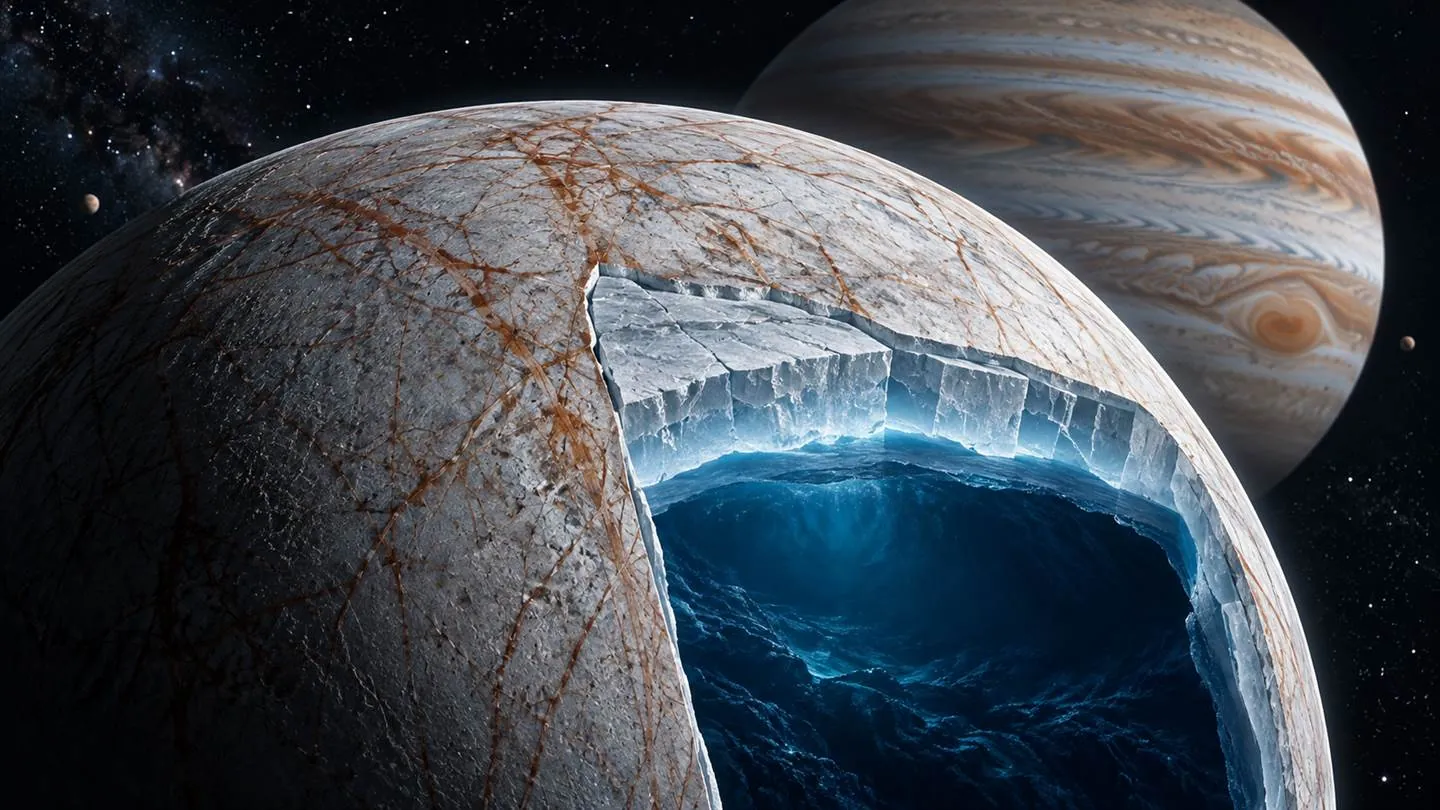
A moon that keeps its secrets
Europa is one of Jupiter’s moons. From far away it looks like a bright ball of ice, crossed by long fractures and ridges. Those surface markings are part of the reason this small world became one of the Solar System’s most intriguing places to investigate.
The central idea is striking: beneath the frozen exterior, Europa may contain a global ocean of liquid water. But “may” matters. No spacecraft has looked through the ice and photographed that ocean. Scientists infer it from measurements and from the way Europa behaves.
A magnetic clue, not a picture
NASA’s Galileo spacecraft made repeated close passes by Europa in the late 1990s and early 2000s. Instruments detected changes in Jupiter’s magnetic field around the moon. One explanation is that a conductive layer inside Europa responds to that changing field and creates an induced magnetic signal.
Given Europa’s icy composition, a salty liquid ocean beneath the crust is a strong explanation for that signal. It is evidence about the interior—not a direct image of it. The distinction is important: a scientific model can fit observations very well while still leaving details such as the ocean’s depth, chemistry and exact structure for future measurements to test.
Europa’s young-looking, fractured surface provides another part of the picture. Its geology suggests that the outer shell has been shaped and stressed over time. These features help scientists ask how the ice and interior interact; they do not, on their own, prove that a particular ocean exists at a particular depth.
Where the heat could come from
Europa travels around Jupiter, whose gravity changes the strength and direction of its pull as the moon moves along its orbit. That repeated flexing can deform Europa. Tidal motion may dissipate energy as heat inside the moon, helping explain how liquid water could persist beneath an icy surface so far from the Sun.
This is a plausible energy source, not a measurement of a warm, habitable sea. The amount and distribution of heat depend on properties scientists are still investigating, including the thickness and behavior of the ice shell and the structure of the interior.
Water is not the same as life
Liquid water is one ingredient considered relevant to life as we know it. It is not proof of life, and it is not enough by itself to establish that a place is habitable. Chemistry, usable energy and the way materials move between the ocean, seafloor and surface all matter too.
No life has been discovered on Europa. Researchers are studying whether the moon might offer conditions worth investigating, not reporting a biological detection. That boundary should remain clear whenever the possibility of an ocean is discussed.
What future measurements can add
NASA’s Europa Clipper mission is designed to investigate whether Europa has conditions that could support life. Its observations can refine measurements of the moon’s ice, composition and response to Jupiter’s tides. They will help test the ocean hypothesis and narrow the questions researchers can ask next.
For now, the careful summary is both exciting and limited: Europa is a moon of Jupiter; several lines of evidence suggest a subsurface ocean; tidal heating may contribute energy; the ocean has not been directly photographed; and no life has been found there. The unknowns are not a flaw in the story. They are the reason the investigation continues.