TST LAB / TST Wonders
Why the Moon Is Slowly Moving Away from Earth
Laser measurements show the Moon’s mean distance increasing by about 3.8 centimetres a year today. The cause is tidal exchange between Earth’s spin and the Moon’s orbit—not a straight-line journey to escape.
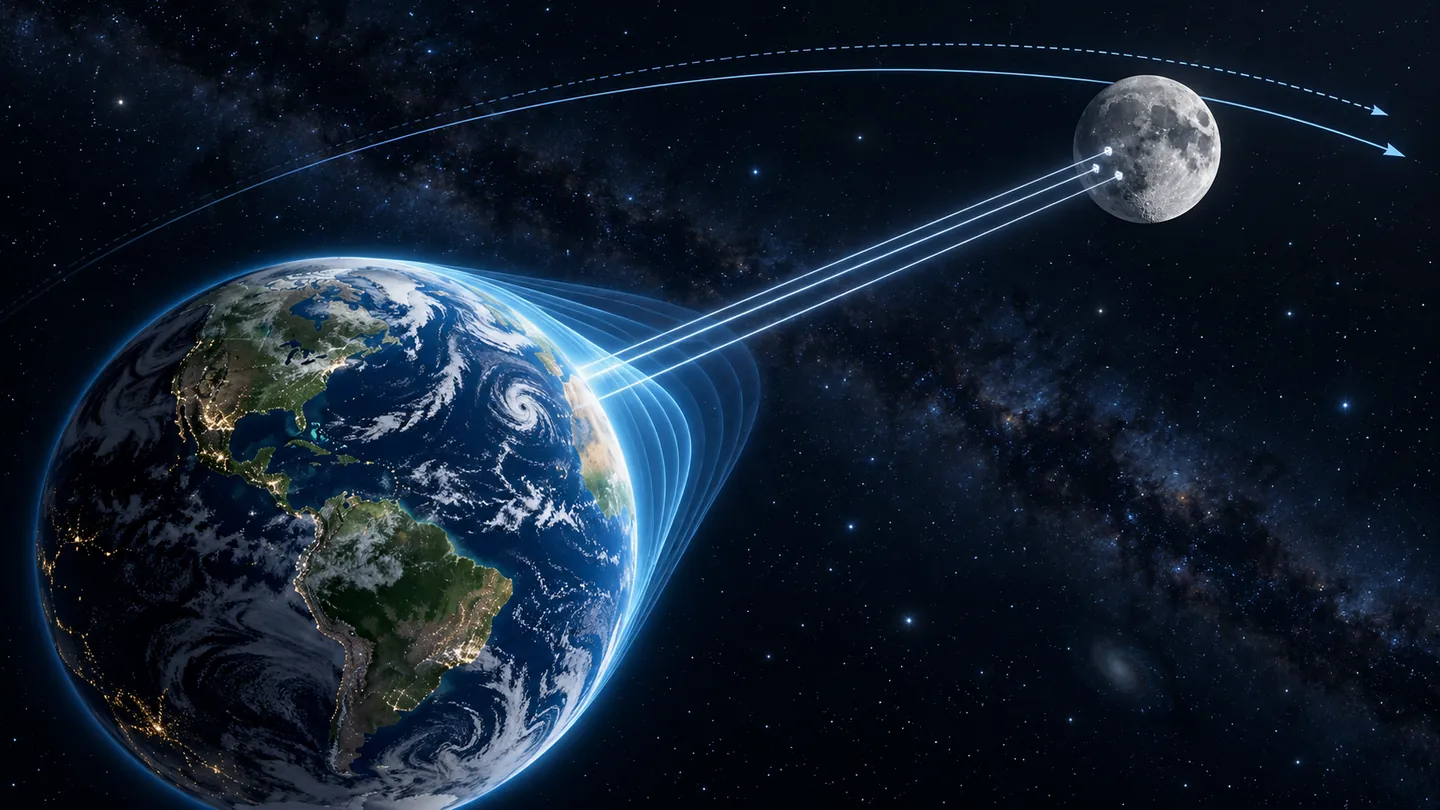
A distance measured with a stopwatch made of light
The Moon’s mean distance is not fixed. Lunar laser ranging measures the travel time of laser pulses sent from Earth to retroreflectors placed on the lunar surface by Apollo missions and Soviet robotic missions. By timing the returning light and modelling the motion of Earth, Moon and stations, researchers determine the changing Earth–Moon distance with high precision.
NASA summarizes the present recession as about 3.8 centimetres per year. That is a long-term mean orbital change, not a smooth daily motion that can be read from one observation. The Moon’s distance also varies through each orbit, and the rate quoted describes a secular trend inferred from a decades-long measurement record.
Why the orbit gains distance
The Moon raises tides on Earth. Because Earth rotates faster than the Moon goes around it, the tidal response is carried slightly ahead of the Earth–Moon line. The gravitational pull between that offset tidal mass and the Moon exerts a torque: Earth’s spin slows a little while the Moon gains orbital angular momentum and moves into a wider orbit.
Energy is dissipated through tidal friction, especially in the oceans. Angular momentum is exchanged within the Earth–Moon system; it is not created from nothing. The same interaction that lengthens Earth’s day gradually increases the Moon’s orbital period and mean distance.
The present rate is not a universal constant
The 3.8-centimetre figure is a measurement of the present era, not a rate to multiply unchanged across Earth’s history. Geological records and orbital models indicate that lunar recession has varied. A 2024 study reconstructing parts of the last 650 million years estimated different average rates across several broad intervals and discussed how ocean-basin geometry and Earth’s changing rotation affect tidal dissipation.
That dependence makes physical sense: coastlines, continental shelves, ocean depth, sea level and the speed of Earth’s rotation shape how tides move and lose energy. Resonance between tidal forcing and ocean basins can change the amount of dissipation. The study also notes uncertainties in reconstructing ancient bathymetry, so its past rates are estimates with stated limits, not a perfectly known year-by-year history.
Not an imminent escape
At a few centimetres a year, the change is imperceptible to a person watching the night sky. The number does not mean the Moon is on a simple straight path out of Earth’s gravitational reach. It describes the current tidal evolution of a coupled system, whose forcing and dissipation change as the orbit and Earth itself evolve.
The reliable conclusion is both modest and remarkable: the distance is changing, laser ranging measures that change, and tides explain the present trend. Extrapolating today’s rate indefinitely would ignore the changing physics—and turn a careful measurement into a misleading prediction.